Evaluations – The Human Condition
For this project I decided I wanted to make a set of images to present, after a lot of thinking I came up with the idea of doing various mental and personality disorders. This idea lead me straight to look at Emilie Autumns’ “The Asylum for Wayward Victorian Girls,” specifically her drawings of leeches and their various mental disorders, I liked the way she had portrayed them almost abstract, rather than the obvious. My first approach to photographing my idea was going to be very surreal and abstract – as if the feelings of the person were displayed outside of them, but I couldn’t quite work out how to do it. After a while my idea developed into more literal representations of the various disorders, and almost cliché. I decided I would present it as a documentation from and old Victorian asylum, as an almost catalogue of the insanity. As it was supposed to be Victorian I think the cliché approach works because it’s supposed to be through the eyes of a Victorian – how they would portray “mad girls.” As a society that generally shunned anything that wasn’t the social norm, and if you were a woman especially, anything could get you locked up in an asylum. I suspect there may have been some males who had quite a fetish for the mad girl, and in that way this book could be seen as a book that was meant to sell the girls – though this is not what I was going for.
I decided to portray four disorders; Insomnia, Nymphomania, Bulimia Nervosa and Multiple Personality Disorder.
For insomnia I decided to highlight the use of clocks, and purchased a huge clock to use as a prop. I think clocks are significant if you have insomnia because when you’re trying to get to sleep and know you have to wake up early in the morning it can be torture listening to the clock ticking away. I got in touch with a make-up artist and explained my concept to her and we came up with massive bed hair, and dark circles around the eyes. I took inspiration from Emilie Autumn’s song ‘4 o’clock’ and the model I used came up with an outfit which was made up of a corset, frilly knickers and stockings. She managed to incorporate a large pocket watch attached to the corset which was set to 4 o’clock (the large clock was also set to 4) The final images I chose where both using the lensbaby; one of them is a picture of her standing there looking quite dazed and sleepy, and the other is a picture of her holding the clock. I think these images works well together as they are both very similar with the one difference being the clock prop. I think the way she’s holding the clock in the 2nd image signifies the importance of time.
For Nymphomania I didn’t want to go down the sleazy route, and the disorder isn’t exactly nymphomania, she’s just a wayward seductress and a general menace to society who can’t help but take her clothes off all the time. She often tries to seduce the guards. Rather than doing the obvious with this I wanted to go more down the burlesque route, as I think it’s more in keeping with the whole theme. I think the images turned out well and the model helped this a lot. In the first image she is showing a more mysterious pose, whereas the second is cheekier.
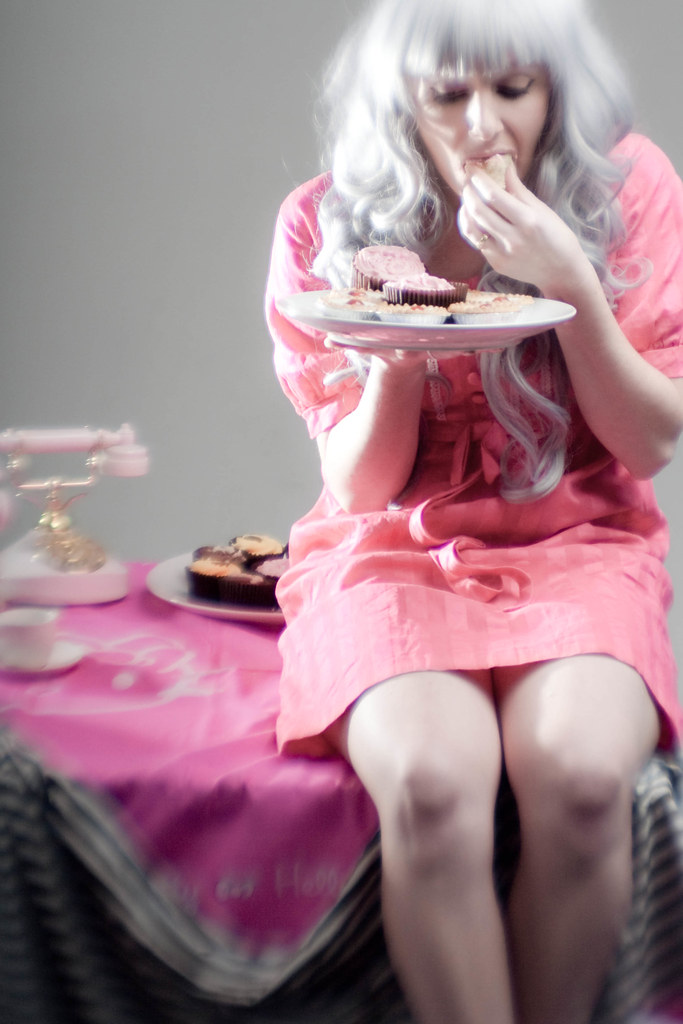
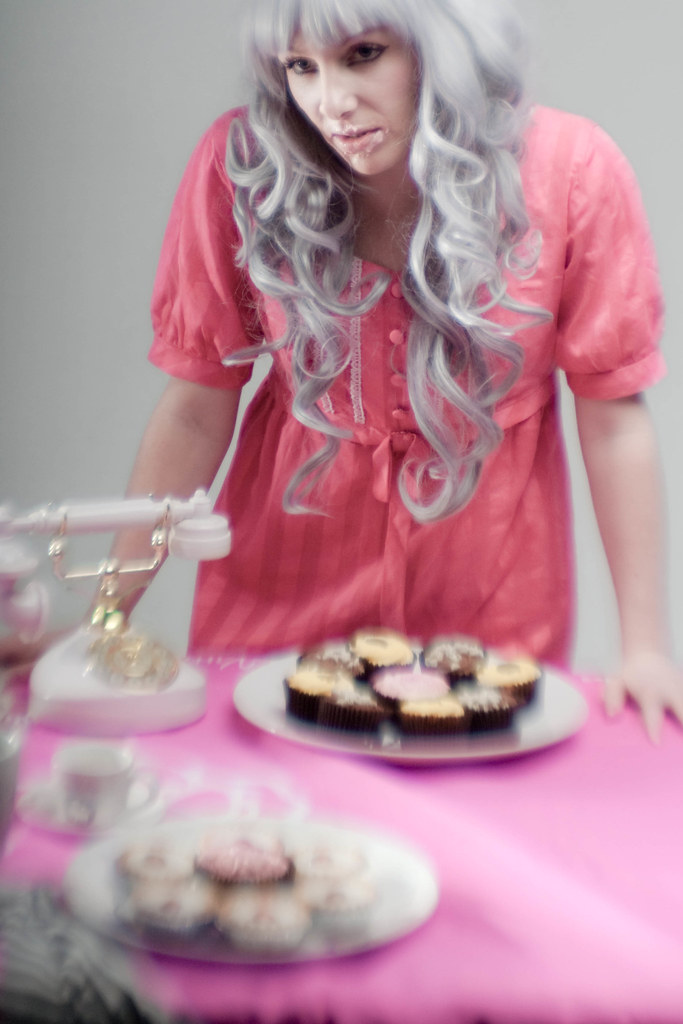
For Bulimia I decided to get lots of cupcakes and a table and make it seem like a tea party, I wanted one image of her eating the cakes and the other image of her looking quite sick and displeased with herself, I think I achieved this. I don’t think these images really fit in with the others that well, I think this is because of the table – all of the other images are just simple portraits.
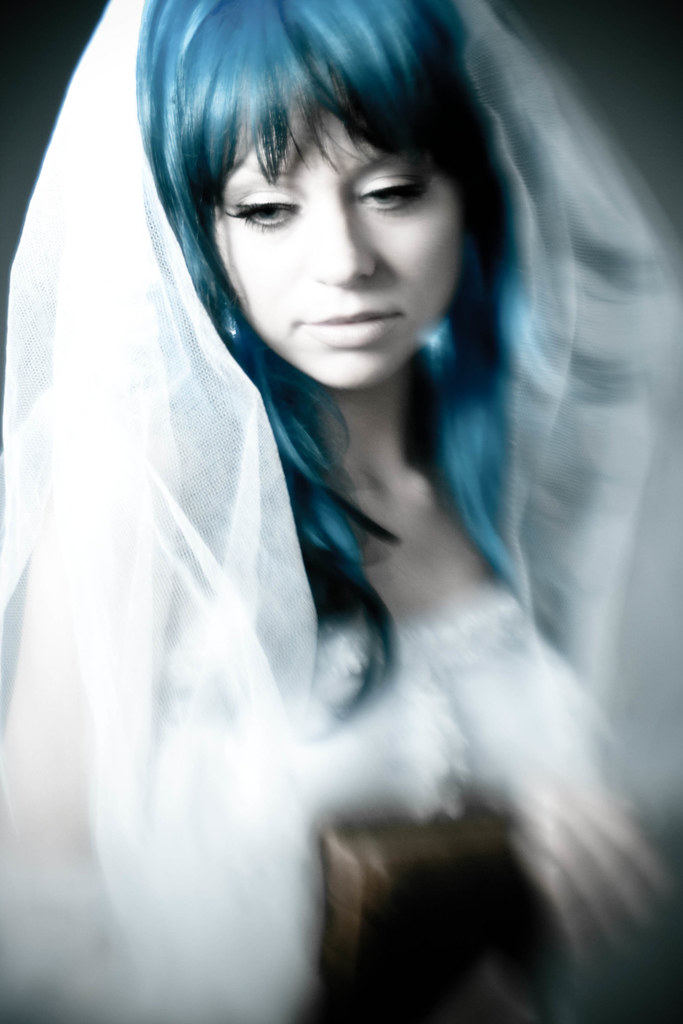
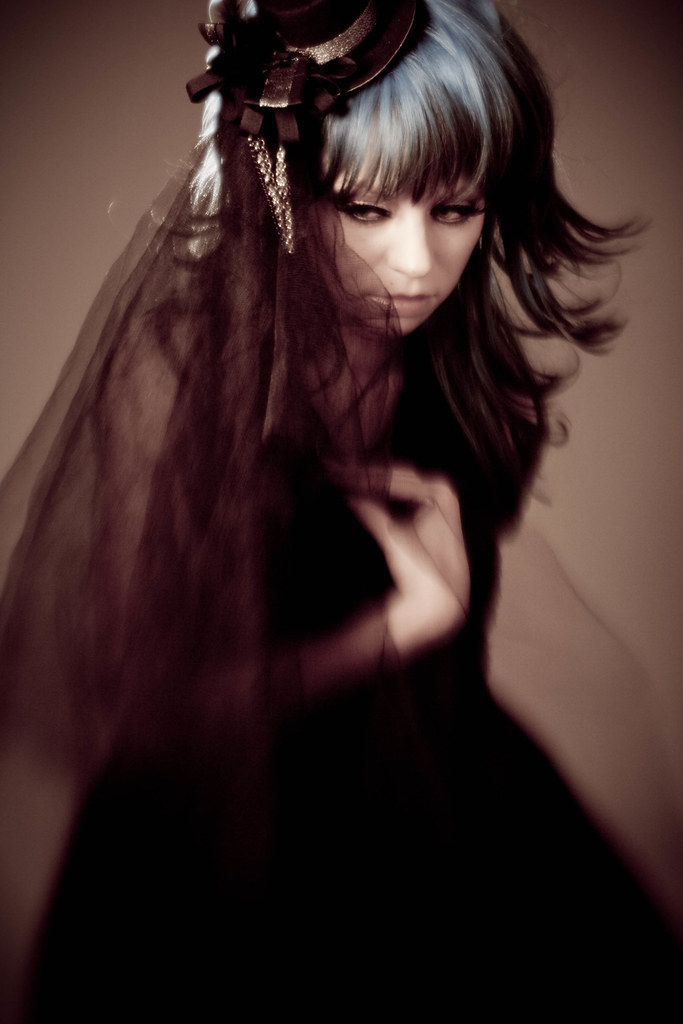
For Multiple Personality Disorder I decided to portray the dark and light sides of her personality, this is mostly shown in the outfits, but the model did a very good job with posing and played both roles very well. The light image is supposed to look very angelic and she’s holding a book that’s supposed to be the bible, in contrast the dark image is a bit gothic and her expression looks a bit vindictive. I think the outfits work very well as they are both quite similar yet in opposite colours.
I decided to present my images in an old Victorian cartes de visite album – in keeping with the theme, although the book may be a little small it works perfectly. I have presented the images in two’s and included quotes and a very small ‘admittance sheet’ stating the name, age, sex, form of insanity, if they’re suicidal and if they’re dangerous to other or property. As my images were meant as a set, I used a Lensbaby and the same lighting – butterfly lighting with a beauty dish and a honeycomb for backlighting for every image. In post production I also edited all the images the same, I made a sepia action that still kept a hint of colour, with a vignette, and I later added a texture overlay to add to the vintage feel. For the most part, I think my images turned out well and are not as cliché or obvious as I first suspected they would be.
Overall I think the book works very well as a set and I have done a good job in creating images that fit with each other.